--nproc: Followed by a number, specifies the number of processes.
--method: {sin_poly, fft}
sin_poly: Least squares fitting of polynomial + sinusoidal.
fft: Operates in Fourier transform’s phase space, retrieves SW
by inverse Fourier transform.
--njoin, --s_method_t, --s_sigma_t,
--s_method_freq, --s_sigma_freq, --average_every_freq
similar to hifast.bld,
--njoin not supported with --methodfft.
--nobld: Return data without baseline removed, only SW removed,
suffix ‘-sw_nobld.hdf5’.
--methodfft: Pre-process significant RFI or signals, then removes
SW components via FFT filtering.
Preliminary Parameters
--rms_frange: Frequency range for RMS calculation, choose range
without signals/interference. E.g., --rms_frange14001410.
If not specified, determined automatically.
First, replace the strong signals and RFI with fake standing wave.
RFI and strong signals (like Milky Way) create low-frequency interference
in Fourier space, affecting SW identification. Substitution necessary.
hifast’s --rfi_method defaults to near_ripple, assumes nearby SW
patterns similar, used for filling areas needing substitution.
First, smooth the original data:
First smoothing, to locate positions needing substitution. Utilizes
time and frequency directions, preserving weaker signals.
Parameters: --s_method_t, --s_sigma_t, --s_method_freq,
--s_sigma_freq
Second smoothing, to identify SW troughs, aligning them with original
troughs during substitution. If --s_method_t_T, --s_sigma_t_T,
--s_method_freq_T, --s_sigma_freq_T not given, same parameters
used.
Temporal smoothing may expand substitution areas. If --s_method_t
not none and restrict_boundTrue, third Gaussian smoothing
in frequency direction with --rms_sigma to limit substitution area.
For smaller signals, omit this step, or if edge accuracy not critical,
set restrict_bound to False.
Substitution Parameters:
--times_thr: Multiples of RMS identified as noise (no smoothing)
--times_s_thr: Multiples of RMS for substitution (first iteration)
--times_s_thr2: Multiples of RMS for substitution (second iteration)
--rfi_width_lim: Width threshold for RFI/signals substitution
--ext_sec: Number of channels to extend on both sides
--ext_freq: First extend frequency ends (MHz), find lowest points
on both sides of strong signals for substitution, default 1.3.
Note: --rfi_width_lim, --ext_sec similar in meaning for RFI marking.
hifast sets RMS multiples for substitution areas.
First iteration, --times_thr as non-smoothing threshold for outliers
(like narrow-band RFI), and --times_s_thr as smoothing threshold
for SW troughs. If weaker signal flow requirements low, second iteration
may be unnecessary.
First iteration substitution diagram (interactive mode).#
Second iteration (--iter_twice) effectively performs SW removal first,
then identifies areas for substitution. Only once may result in excessive
substitution (as SW amplitude affects results).
is_excluded includes RFI and potential signal parts. If SW removal
first without baseline removal (sw_nobld), and baseline removal (bld)
next step, is_excluded included in bld.py to read its is_excluded,
preventing overfitting of baseline to signals.
If --save_is_excludedTrue, is_excluded generated, passed in
second iteration.
--sw_base: Removes constant components in Fourier space. If baseline
deviates from 0, setting True shifts entire spectrum by constant value.
--sw_periods: SW components to be removed. Accepts multiple characters.
Default 1mhz0_04mhz. Characters and corresponding SW periods:
Character
SW Period (MHz)
1mhz
1.08
2mhz
1.92
0_04mhz
0.039
Note: 2mhz SW rarely seen, only once in M06 YY, so need not be added
--check_2mhz: If True, adds 2mhz to --sw_periods when inputting
Beam 6 files; if not Beam 6, removes 2mhz (if present). Except data from
July 31, 2021, do not set this parameter to True.
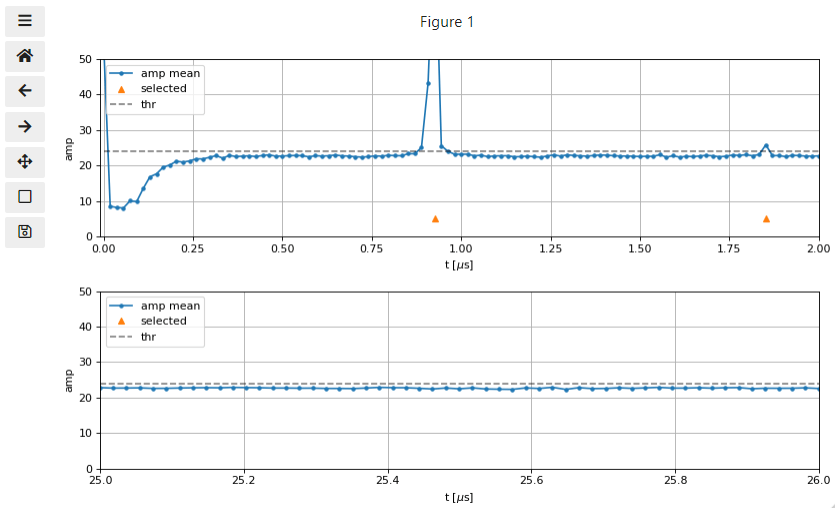
--amp_thr_mean_factor: Modes by average amplitude threshold in Fourier
space, identified as known SW types. Input as multiple of median. Corresponds
to two thresholds for noise switch off/on.
--amp_thr_solo_factor: SW parts by individual spectral line amplitude
threshold in Fourier space. Input as multiple of median. Corresponds to two
thresholds for noise switch off/on.
--chan_wide: Modes within ±(2 * channel number - 1) channels from SW mode
center, selected as part of SW. Used for 1mhz and 2mhz SW. Default 5.
--chan_narr: Similar to above, but for narrow-band parts. Used for
0_04mhz SW and multiples of 1mhz. Default 2.
--choose_method: Method for selecting modes in Fourier space as SW,
all or interpolate. Default all.
Noise Off (Cal_off) Spectral Line Processing
SW amplitude and phase affected by noise switch changes, need separate processing.
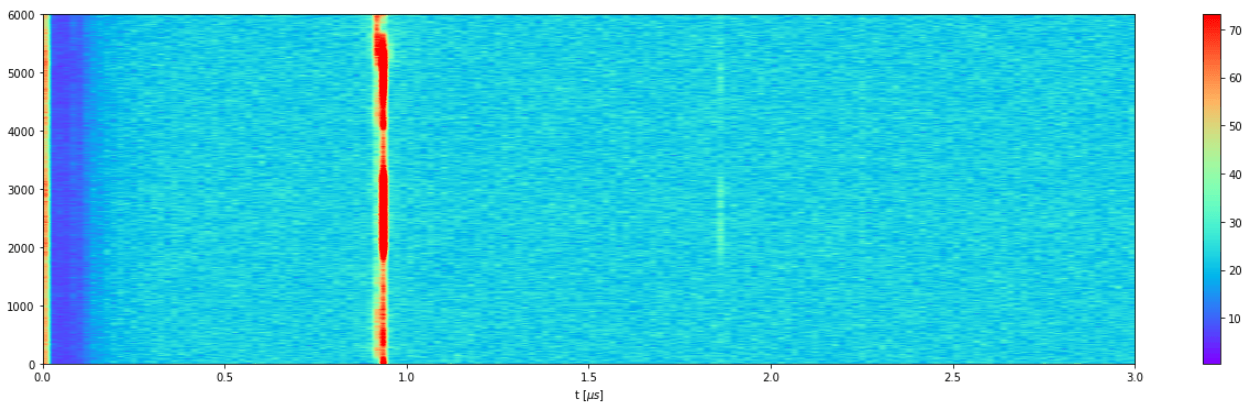
Amplitude in Fourier space, 0.92 microseconds corresponding to 1MHz SW,
1.84 microseconds to double frequency.#
Adjust --amp_thr_mean_factor through interactive page
Average amplitude in Fourier space, peaks for two SW exceed threshold.#
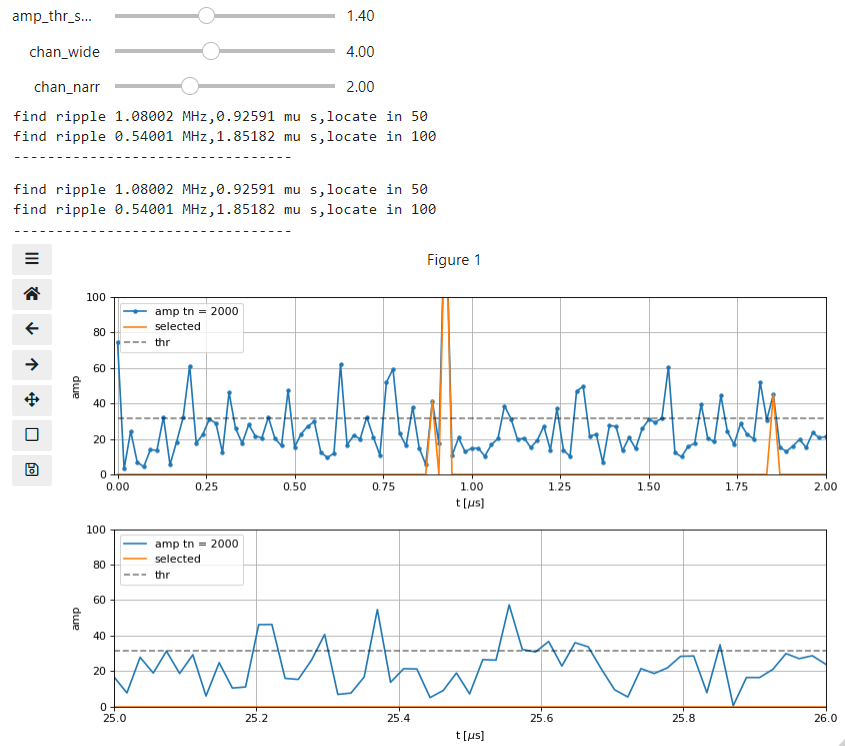
Adjust --amp_thr_solo_factor through interactive page
Individual amplitude in Fourier space, peaks for two SW exceed threshold,
--chan_wide and --chan_narr cover necessary peaks.#